Free · Worked example · 14 problems · Answer key · US Letter
How to do it
If P(c) = 0, then x − c is a factor. Divide it out, then factor the quadratic that is left.
x3+x2−10x+8;x+4 is a factor→(x+4)(x−2)(x−1) x3+x2−10x+8=(x+4)(x2−3x+2)the bottom row is the other factor (x+4)(x2−3x+2)=(x+4)(x−2)(x−1)factor the quadratic Example problems
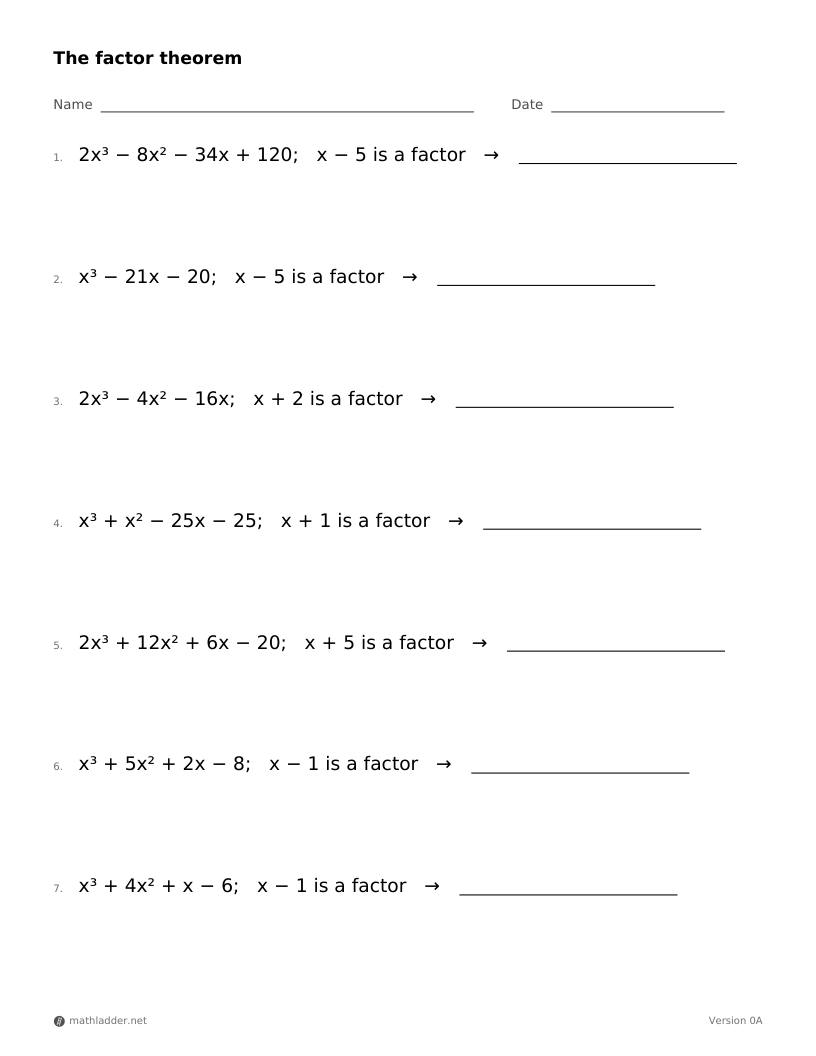
- 2x3−8x2−34x+120;x−5 is a factor→
- x3−21x−20;x−5 is a factor→
- 2x3−4x2−16x;x+2 is a factor→
- x3+x2−25x−25;x+1 is a factor→
Quadratic and polynomial functions
- Vertex form of a quadratic
- Finding the vertex from standard form
- The discriminant
- Quadratic equations with complex roots
- Polynomial long division
- Synthetic division
- The remainder theorem
- The factor theorem
- The rational root theorem