Free · Worked example · 18 problems · Answer key · US Letter
How to do it
The derivative is the rate of change: velocity is the derivative of position.
s(t)=2t3−2t2−8t+7 is a position. Velocity at t=4→72 v(t)=s′(t)=6t2−4t−8velocity is the derivative of position v(4)=6(4)2−4(4)−8=72 Example problems
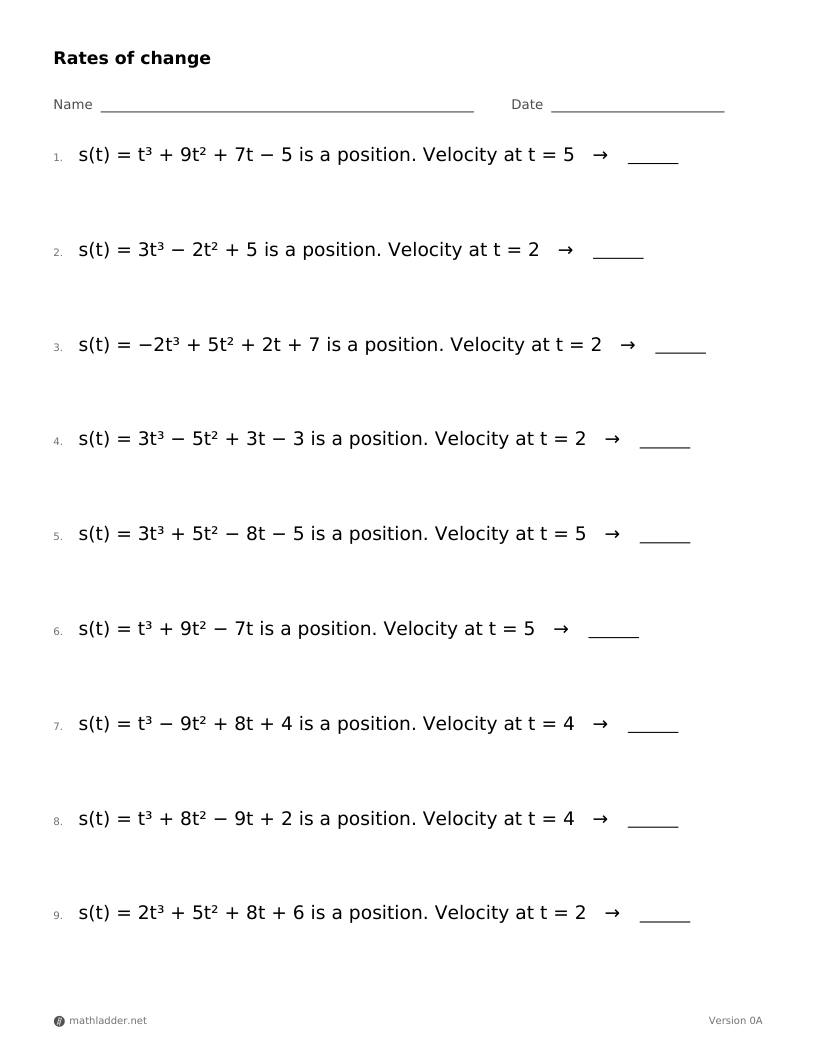
- s(t)=t3+9t2+7t−5 is a position. Velocity at t=5→
- s(t)=3t3−2t2+5 is a position. Velocity at t=2→
- s(t)=−2t3+5t2+2t+7 is a position. Velocity at t=2→
- s(t)=3t3−5t2+3t−3 is a position. Velocity at t=2→
Limits and derivatives
- Evaluating limits
- The power rule for derivatives
- The product rule
- The quotient rule
- The chain rule
- Derivatives of trig, exponential and log functions
- Equation of a tangent line
- Derivatives as rates of change
- Finding maximum and minimum points