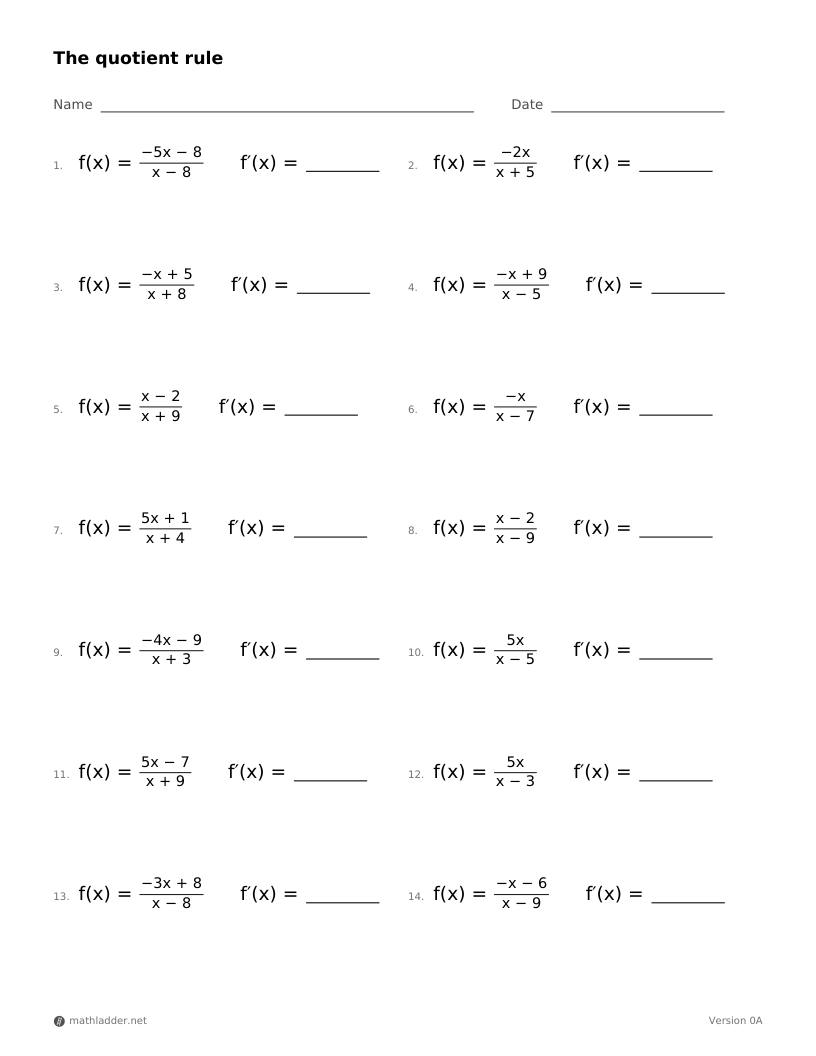
Free · Worked example · 29 problems · Answer key · US Letter
How to do it
(u ÷ v)′ = (u′v − uv′) ÷ v². Leave the denominator squared.
f(x)=x+54x−7f′(x)=(x+5)227 f′(x)=(x+5)24(x+5)−(4x−7)(1)(u/v)′ = (u′v − uv′) ÷ v² 4(x+5)−(4x−7)(1)=27the x terms cancel in the numerator Example problems
- f(x)=x−8−5x−8f′(x)=
- f(x)=x+5−2xf′(x)=
- f(x)=x+8−x+5f′(x)=
- f(x)=x−5−x+9f′(x)=
Limits and derivatives
- Evaluating limits
- The power rule for derivatives
- The product rule
- The quotient rule
- The chain rule
- Derivatives of trig, exponential and log functions
- Equation of a tangent line
- Derivatives as rates of change
- Finding maximum and minimum points