Free · Worked example · 14 problems · Answer key · US Letter
How to do it
The average rate of change from x = a to x = b is (f(b) − f(a)) ÷ (b − a).
f(x)=−2x2−x−4;from −2 to 4→−5 f(4)=−2(4)2−(4)−4=−40 f(−2)=−2(−2)2−(−2)−4=−10 4−(−2)−40−(−10)=6−30=−5the change in f over the change in x Example problems
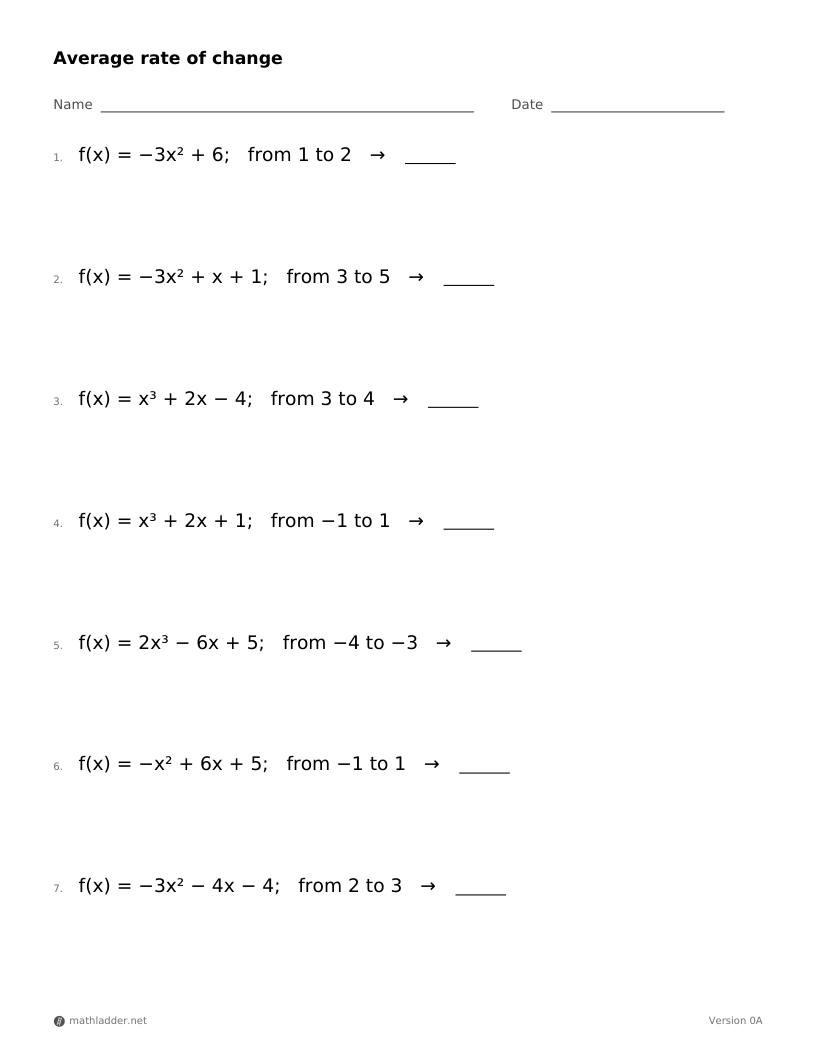
- f(x)=−3x2+6;from 1 to 2→
- f(x)=−3x2+x+1;from 3 to 5→
- f(x)=x3+2x−4;from 3 to 4→
- f(x)=x3+2x+1;from −1 to 1→
Functions
- Evaluating functions
- Finding the domain of a function
- Adding, subtracting and multiplying functions
- Composition of functions
- Inverse functions
- Transformations of functions
- Even and odd functions
- Average rate of change