Free · Worked example · 21 problems · Answer key · US Letter
How to do it
(f + g)(x) = f(x) + g(x), (f − g)(x) = f(x) − g(x), and (fg)(x) = f(x) · g(x). Combine like terms.
f(x)=−4x+9,g(x)=x−8;(fg)(x)=−4x2+41x−72 (fg)(x)=(−4x+9)(x−8)=−4x2+41x−72multiply each term of f(x) by each term of g(x) Example problems
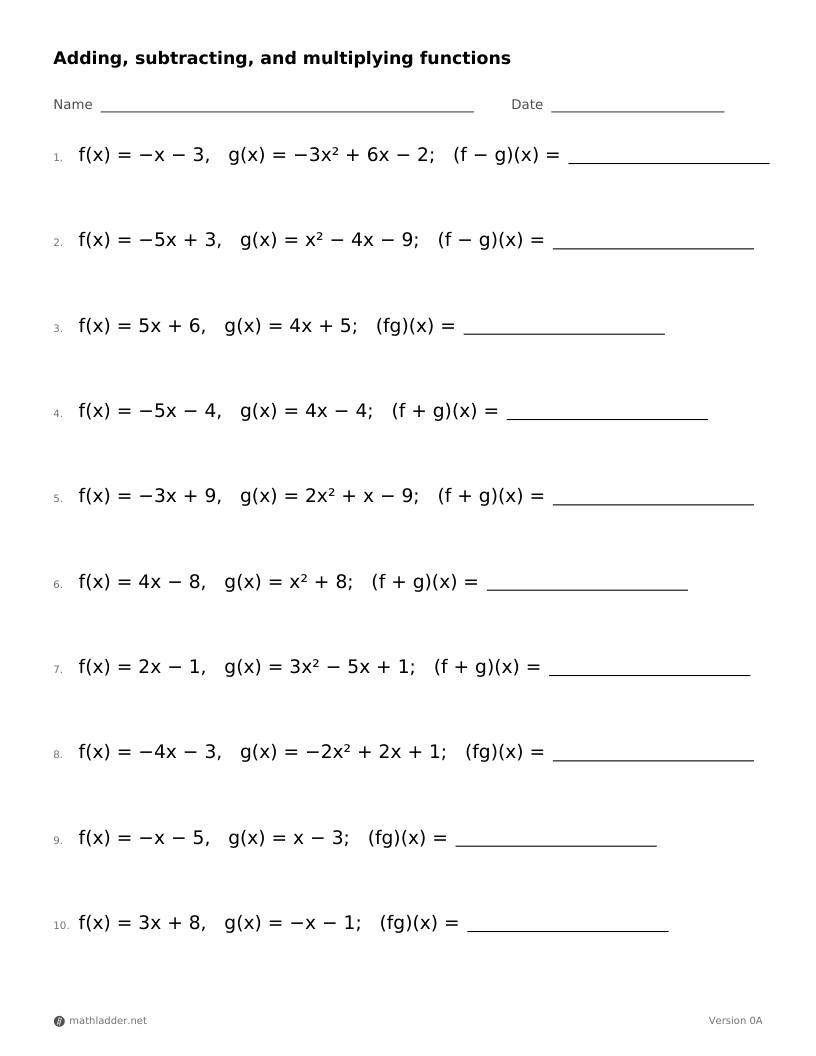
- f(x)=−x−3,g(x)=−3x2+6x−2;(f−g)(x)=
- f(x)=−5x+3,g(x)=x2−4x−9;(f−g)(x)=
- f(x)=5x+6,g(x)=4x+5;(fg)(x)=
- f(x)=−5x−4,g(x)=4x−4;(f+g)(x)=
Functions
- Evaluating functions
- Finding the domain of a function
- Adding, subtracting and multiplying functions
- Composition of functions
- Inverse functions
- Transformations of functions
- Even and odd functions
- Average rate of change