Free · Worked example · 12 problems · Answer key · US Letter
How to do it
The domain is every x you are allowed to use. A denominator cannot be 0, and what is under a square root must be 0 or more. Write x ≠ 3 or x ≥ 3.
f(x)=x−1x+3domain: x=1 x−1=0 when x=1the denominator cannot be 0 Example problems
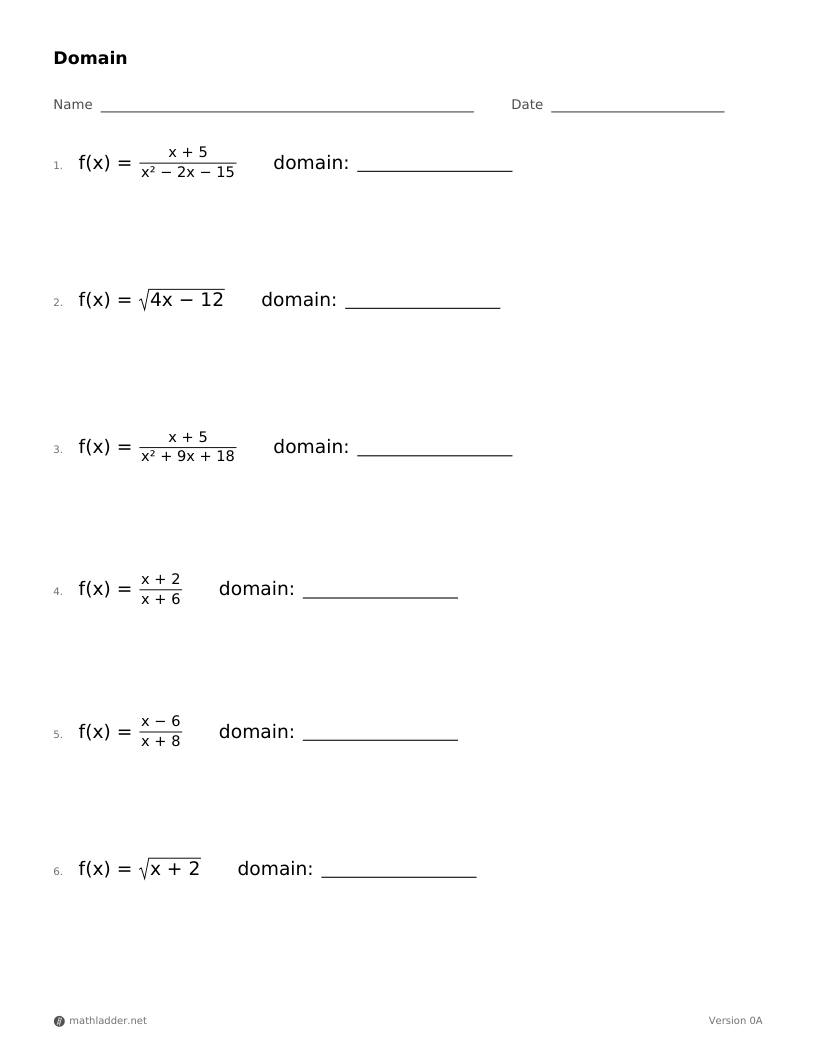
- f(x)=x2−2x−15x+5domain:
- f(x)=4x−12domain:
- f(x)=x2+9x+18x+5domain:
- f(x)=x+6x+2domain:
Functions
- Evaluating functions
- Finding the domain of a function
- Adding, subtracting and multiplying functions
- Composition of functions
- Inverse functions
- Transformations of functions
- Even and odd functions
- Average rate of change